
Maintanance Evaluation Reactor PT-2210
Keeping a polypropylene reactor's pressure reading honest: the transmitter with the final say in its shutdown logic, and the maintenance that keeps it trustworthy.
Polytam is Pertamina's only in-house polypropylene plant, turning out around 42,000 to 45,000 tonnes of plastic pellets a year in Plaju, Palembang. At its centre is reactor D-2201, where liquid propylene meets three catalysts in n-hexane and polymerises into a slurry. The reaction gives off heat, so its pressure has to stay inside a narrow band of 31 to 32 kg/cm². Too high and it becomes a safety problem; too unsteady and the product drifts out of spec.
One instrument watches that pressure for the control room and for the reactor's shutdown logic: pressure transmitter PT-2210. This is a six-week internship with the Maintenance Area II instrument team (2 July to 15 August 2025), spent on how that transmitter is configured, what goes wrong with it, and how it's kept accurate, from biweekly walk-downs to a full nine-point calibration. It ends with a control ticket for its preventive maintenance and a proposal for a redundant measurement on the trip.
At a glance
0–50
kg/cm² measuring range, mapped to 4–20 mA
36 kg/cm²
HIGH-HIGH trip, the interlock's highest-priority input
0.003 mA
Worst as-found error over 9 calibration points (≈0.02 % of span)
4
Maintenance intervals, from biweekly checks to turnaround
The plant and the reactor
The polypropylene unit runs in three stages. Purification takes raw propane-propylene from the refinery's fluid catalytic cracker and strips out its impurities through extraction, sand filtering, drying and distillation, until the propylene is more than 99 % pure. Polymerisation turns it into polymer powder, which is dried and extruded into pellets. Bagging fills those pellets into 25 kg sacks at up to 800 bags an hour.
D-2201 is the heart of the polymerisation stage. Propylene, a main catalyst, a co-catalyst and a third catalyst are mixed in n-hexane, and the reaction runs as a slurry under controlled temperature and pressure. Because the reaction is exothermic, pressure is the variable that tells the control room first when something is getting away from them.

The instrument
Sensor
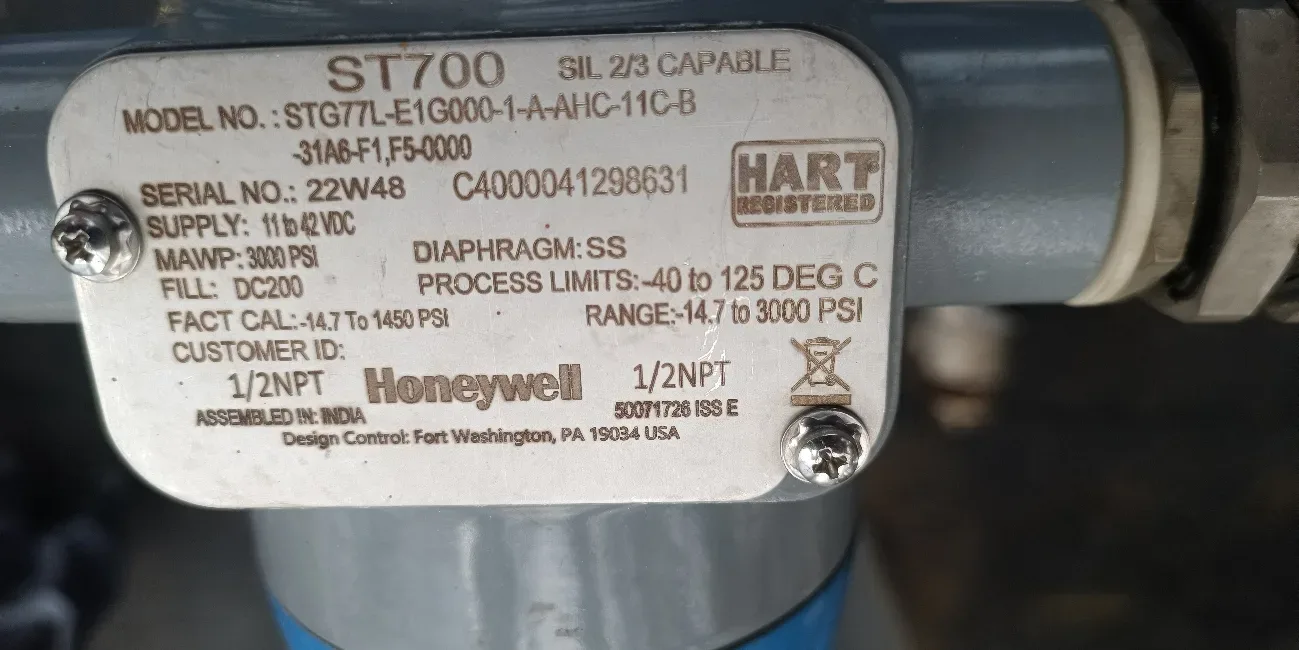
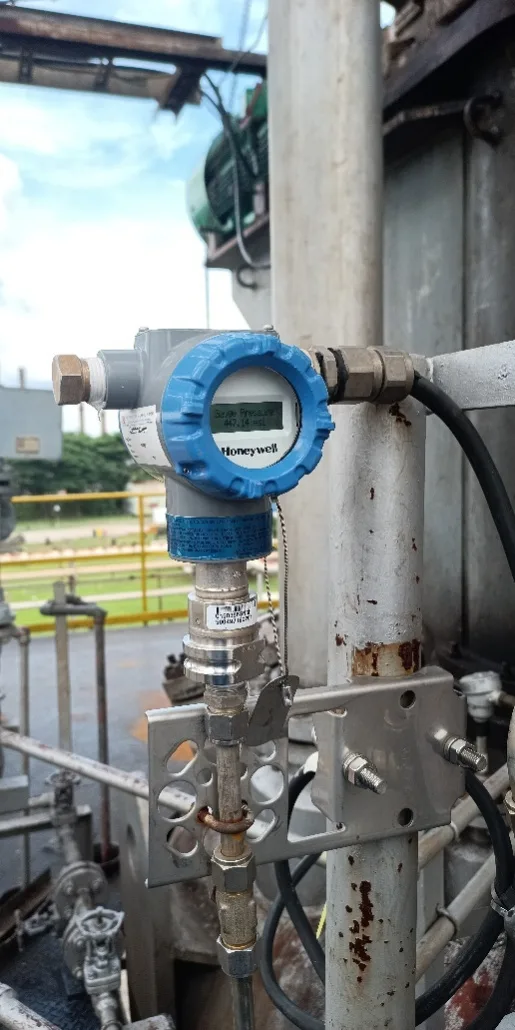
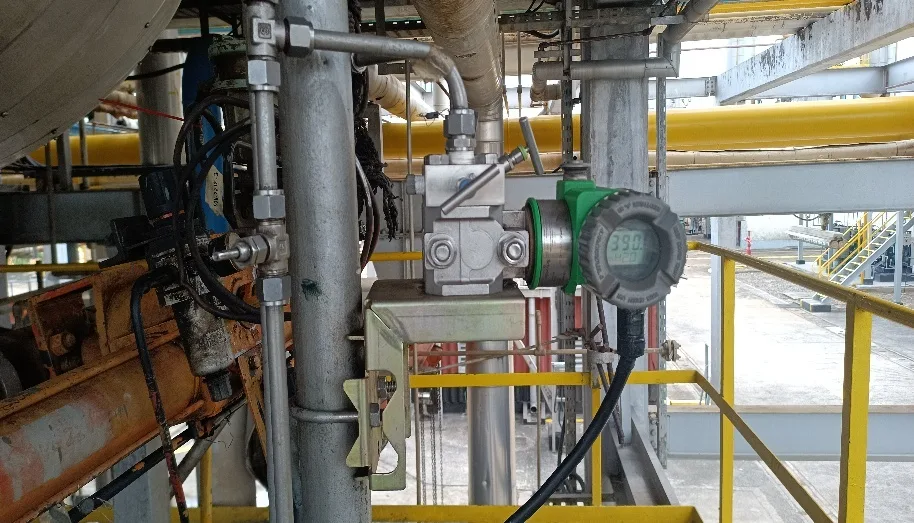
A Honeywell STG77L (ST700 series) gauge pressure transmitter. A strain gauge on a steel diaphragm turns the tiny flex under process pressure into an electrical signal.
Signal
4–20 mA with HART on the same two wires, so the DCS gets the live value while a technician can still talk to the transmitter digitally.
Accuracy
±0.05 % of full scale, ±0.02 % stability over five years and a 100:1 turndown, calibrated for 14.7 to 1,450 psi.
Rating
Process temperatures from −40 to 125 °C, ½" NPT connections, and a SIL 2/3-capable design for use in safety loops.
From pressure to milliamps
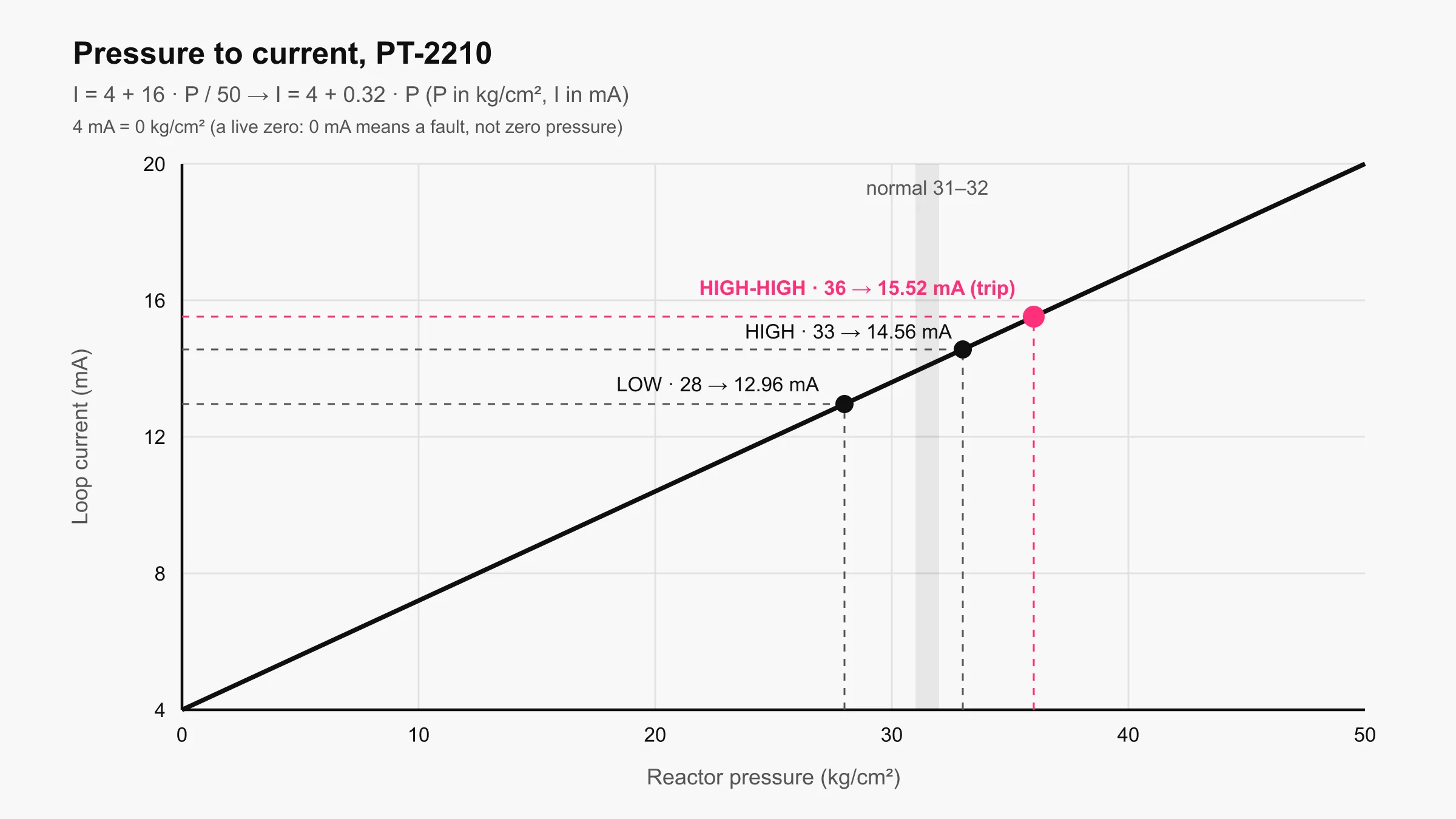
A transmitter's job is to turn a physical quantity into a current the control system can trust. For a linear range from Pmin to Pmax, the current is I = 4 + 16 × (P − Pmin) / (Pmax − Pmin). With PT-2210 ranged at 0 to 50 kg/cm², that simplifies to I = 4 + 0.32 × P: every kilogram per square centimetre adds 0.32 mA.
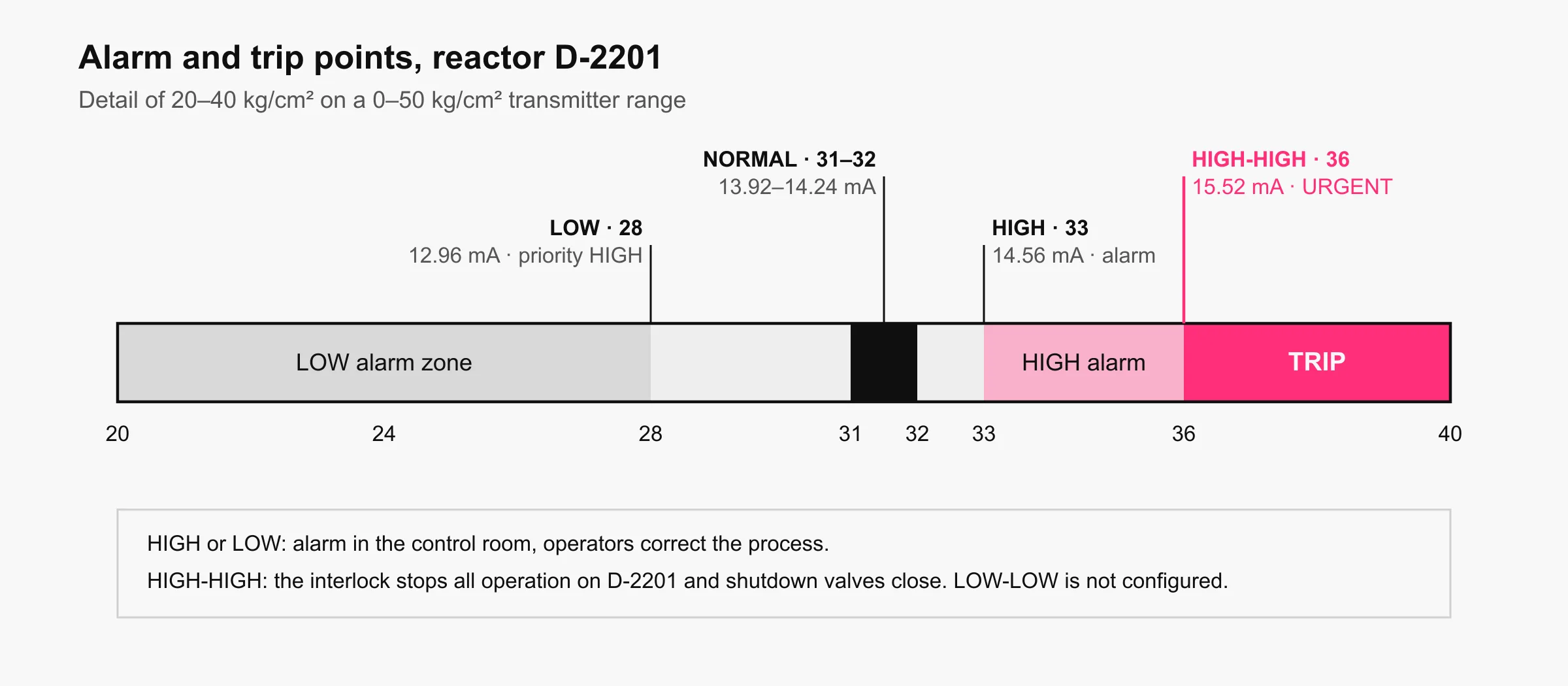
The 4 mA floor is deliberate. Zero pressure still produces 4 mA, a "live zero", so a reading near 0 mA can only mean a broken wire, a dead sensor or a lost loop, never an empty reactor. At the normal operating band of 31 to 32 kg/cm², PT-2210 sends between 13.92 and 14.24 mA.
Alarm and trip points
36
HIGH-HIGH, 15.52 mA · URGENT: trips the reactor
33
HIGH, 14.56 mA · alarm to the control room
28
LOW, 12.96 mA · alarm to the control room
—
LOW-LOW is not configured
The final say in the interlock
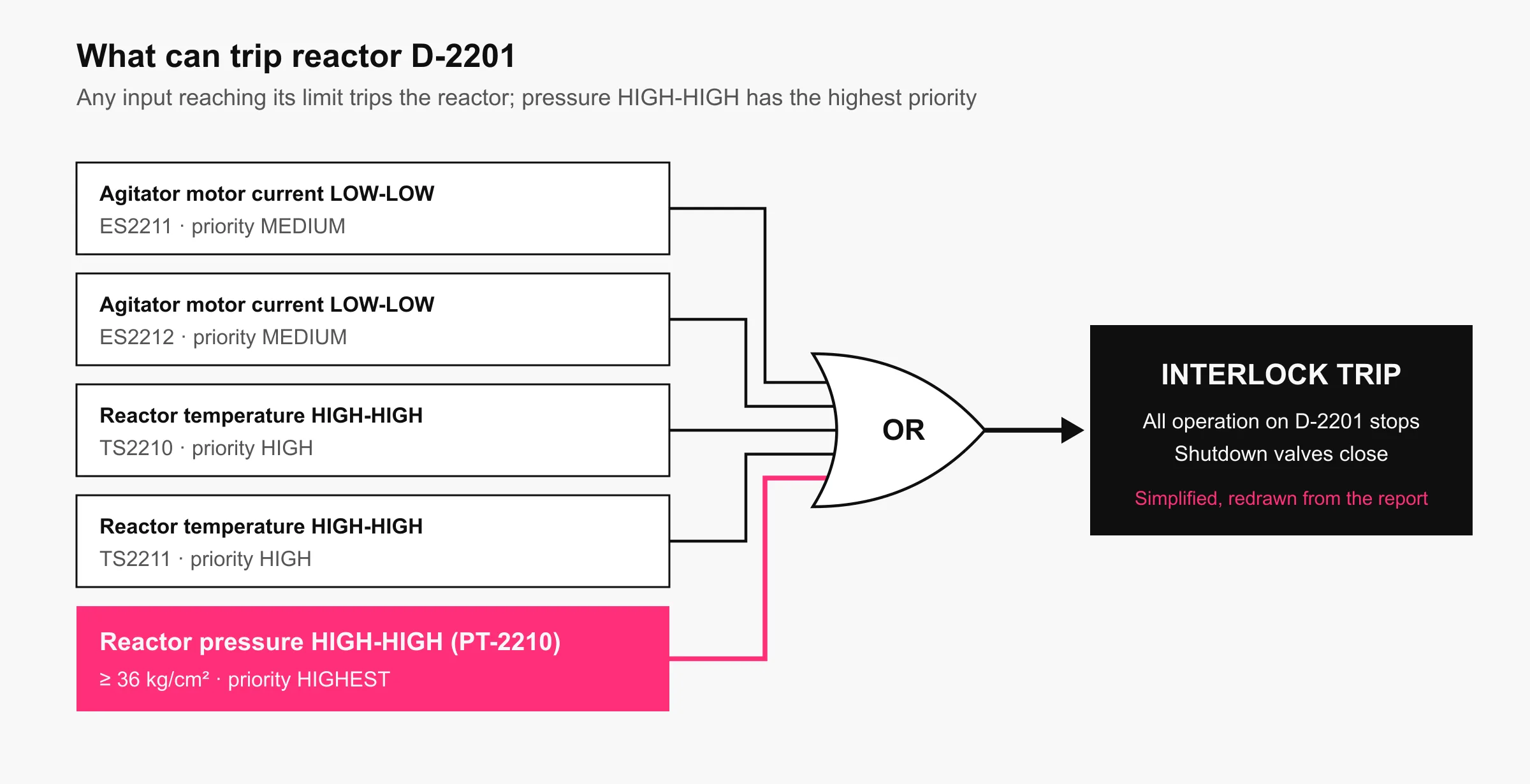
PT-2210 is configured in the DCS as running continuously, with linear PV characterisation and its PV source in automatic. HIGH and LOW are warnings: they raise an alarm and operators steer the process back. HIGH-HIGH is not a warning. At 36 kg/cm² the reactor's interlock trips, every operation on D-2201 stops and the shutdown valves close.
Five signals can trip D-2201: two low-low current alarms on the agitator motor, two high-high reactor temperatures, and PT-2210's high-high pressure. Pressure carries the highest priority of them all. That makes the transmitter's accuracy a safety matter, not just a quality one, which is why a mechanical pressure gauge sits on the same reactor as an independent cross-check in the field.
What goes wrong
Drift
Readings slide slowly off true. Zero drift shows as 3.95 mA when it should be 4.00; span drift as less than 20 mA at full scale; non-linear drift usually means a bent or corroded diaphragm. Age, heat, moisture in the housing and pressure swings all feed it.
Plugged impulse port
Slurry carried in with the propylene settles in the tubing and the port. The tell-tale is a reading that sits flat for too long, or disagrees with the local pressure gauge.
Diaphragm failure
Overpressure deforms the diaphragm permanently, and chemicals or heat corrode it. Output collapses towards 0 mA, stops following the process, or shows values the process can't produce.
Signal interference
Motors, drives and radios nearby couple noise into the loop, and a poor ground leaks current. The signal jumps around in a steady process, drops to 0 mA or spikes. The cure is shielded cable and a solid, shared ground.
Why drift is the dangerous one
A failed sensor is loud: it drops to 0 mA and everyone notices. Drift is quiet. If PT-2210 slowly learns to read low, the reactor can reach a real HIGH-HIGH while the transmitter still reports something comfortable, and the interlock it's supposed to fire never hears about it. Long before that, uncontrolled pressure is already costing product quality.
The defences are layered: the local pressure gauge as a constant second opinion, routine calibration that catches drift before it matters, and a written history of readings so a slow trend shows up as a trend.
Preventive cadence
Every two weeks
Walk-down: cracks in the housing, corrosion on connectors, damaged cables, and whether the local LCD agrees with the process.
Every month
Drain the LP and HP tubing to flush out settled slurry and particles before they plug the line.
Every three months
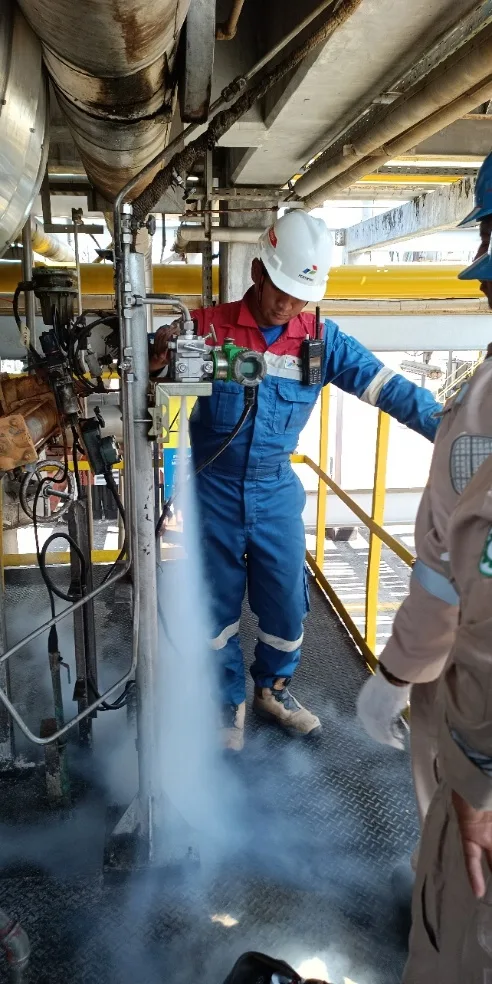
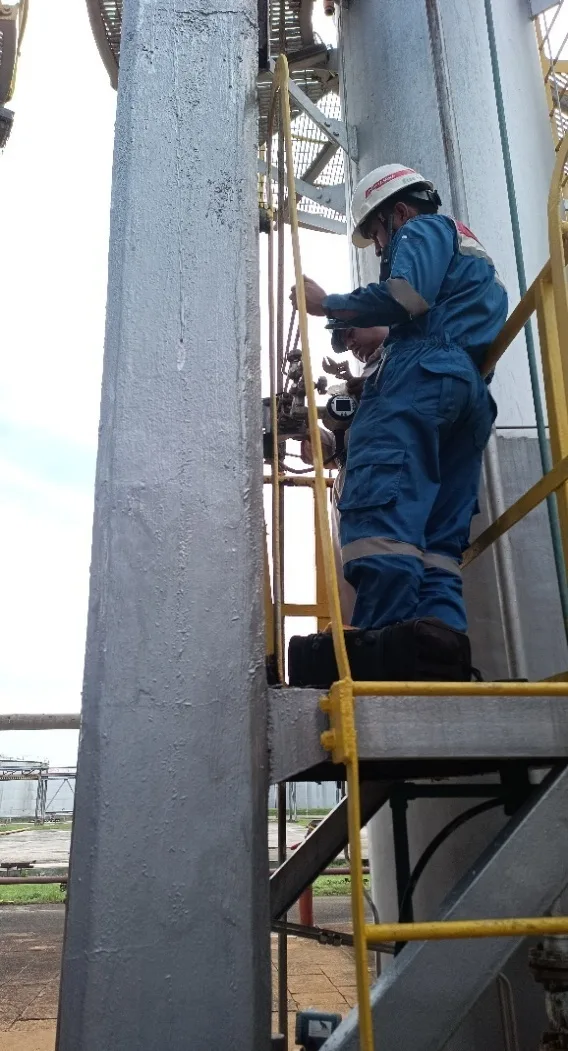
Zero adjustment and a full calibration with a HART communicator, stepping 4 → 20 mA and back down 20 → 4 mA.
Every turnaround
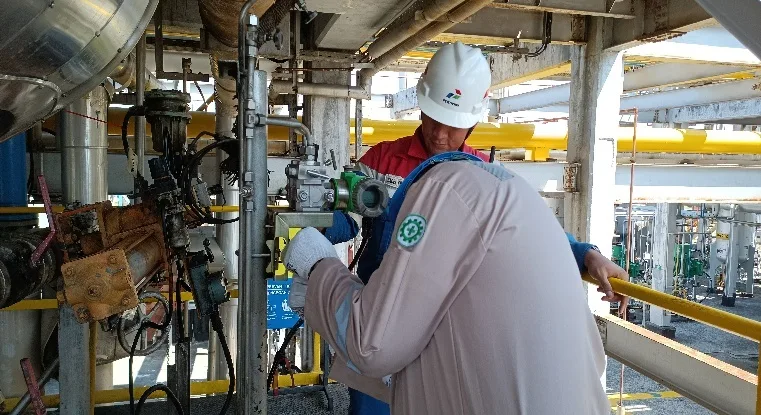
Isolate, dismantle and bench-check inside and out, then recalibrate with a hand pump and HART before it goes back into service.
When it breaks
Corrective work is matched to the symptom. Drift between the field reading and the control room means a full recalibration of zero, span and linearity, right away, because a drifting transmitter is a trip that might not happen. Physical damage, such as a cracked housing, a broken connector or a dead LCD, means replacing the part with a matching spare, or swapping the whole transmitter for one with the same configuration while the old one goes to the workshop. An unrealistic reading points to a blockage, so the tubing is drained and, if needed, replaced.
If the DCS loses the signal or it fluctuates for no process reason, the whole loop gets traced: cables, connectors, grounding and terminals. Every fix ends the same way, by verifying the 4–20 mA signal at the control room, not just at the transmitter.
Calibration, step by step
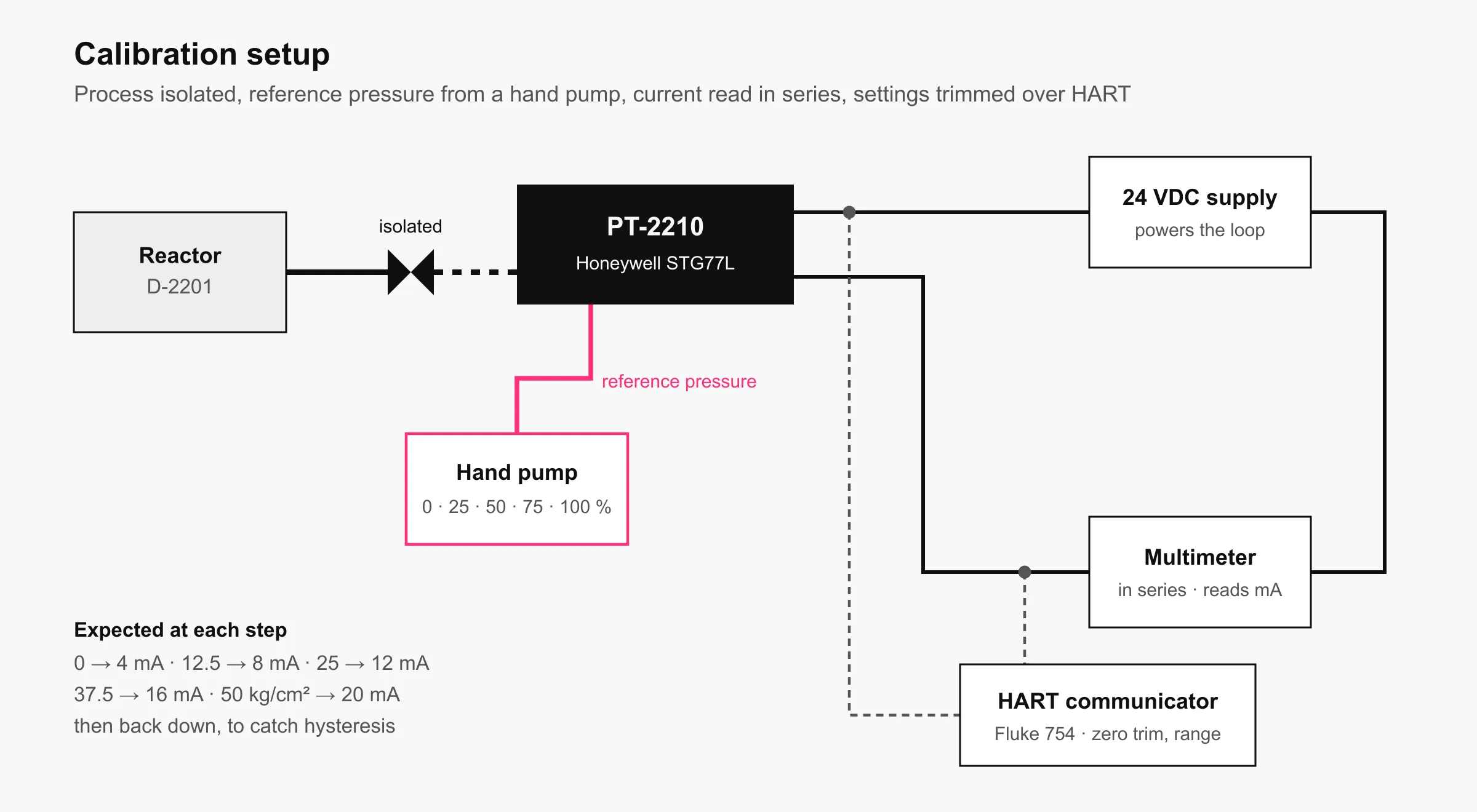
The kit is a pneumatic hand pump for reference pressure, a Fluke 754 HART communicator to read and trim the transmitter, a multimeter in series to read the loop current, and a 24 VDC supply to power the loop.
The control room is told first, then the transmitter is taken out of service and isolated from the process. With the tools connected and no pressure applied, the output should read exactly 4.00 mA; if it doesn't, the HART communicator's zero trim brings it back. Then the hand pump steps the pressure through 0, 25, 50, 75 and 100 % of range and back down again, checking each point against the expected current. A single good point proves nothing: a transmitter can read 4 mA at zero and still show 13.4 mA at half scale instead of 12. Any deviation is trimmed out on zero and span until the whole range lines up.
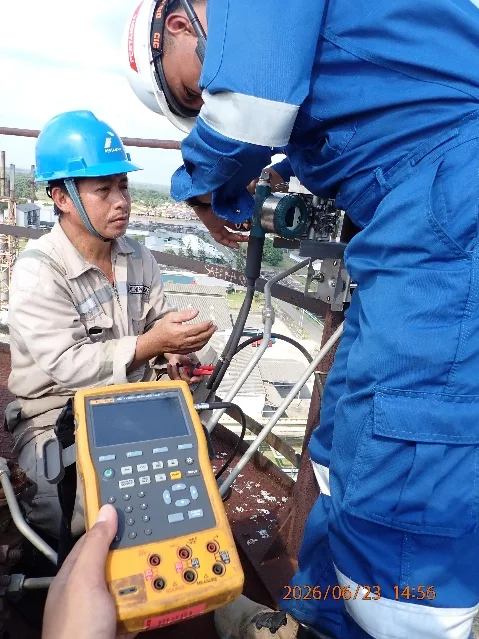

Calibration, 6 July 2025
9
Test points, 0 → 50 → 0 kg/cm² in 12.5 steps
0.003 mA
Worst as-found deviation (8.003 and 16.003 mA)
≈0.02 %
Of span, inside the ±0.05 % accuracy spec
0.000
Deviation at every point after trimming
A control ticket for every task
Preventive maintenance is only as good as its follow-through, and four intervals across many instruments are easy to lose track of. So PT-2210 got a control ticket: one document listing each preventive task, when it's due and whether it's been done. It works as a guide for the technicians doing the work and a record for the engineers checking it, and because past tickets are kept, an unusual entry in an earlier period becomes something to look into instead of something forgotten.
Proposed: a second opinion
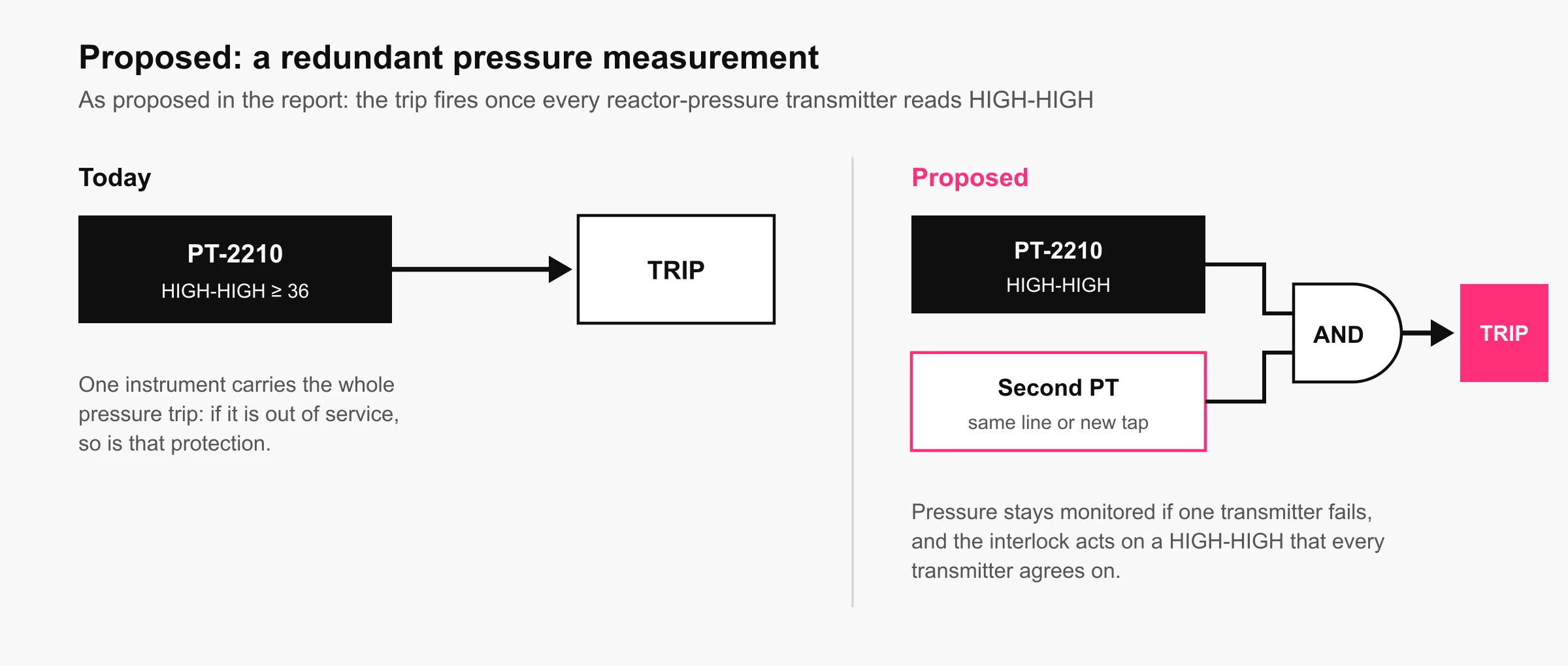
The maintenance programme was working: scheduled preventive work kept PT-2210 accurate, failures came less often, and parts lasted longer. But the reactor's highest-priority trip still rests on a single transmitter. The report proposes adding redundant pressure transmitters, either on the same line or on a new tap on D-2201, so pressure stays monitored even when one unit is faulty or out for service.
With more than one transmitter on the trip, the interlock logic changes too. Under the proposal, the HIGH-HIGH trip fires once every reactor-pressure transmitter confirms the pressure has reached its limit.
Field log
Level transmitter LT-2211
Repaired the transmitter, drained its line tubing and recalibrated it.
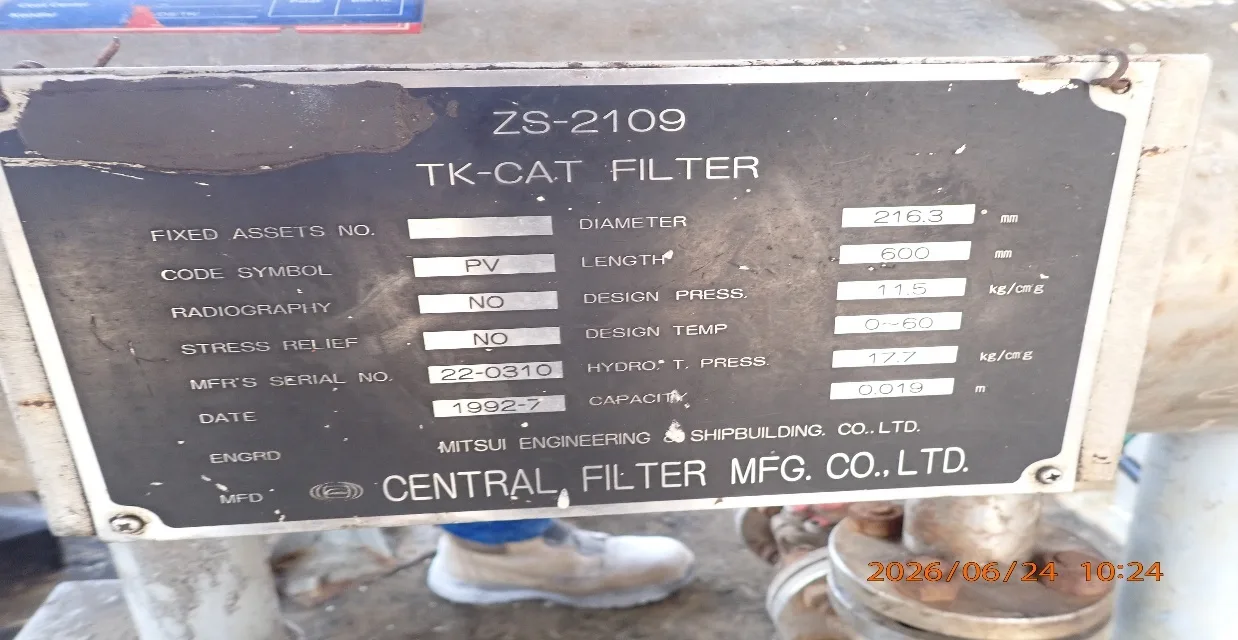
TK catalyst filter
Cleared a blockage in the catalyst filter housing.
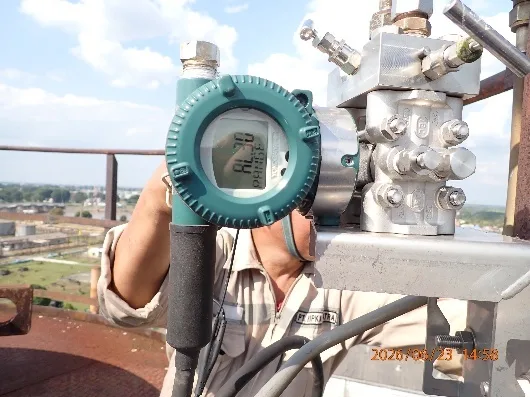
Level transmitter drift
Traced and corrected a drifting reading on a filter level transmitter.
Pressure gauge
Cleared a blocked pressure gauge and its connection.
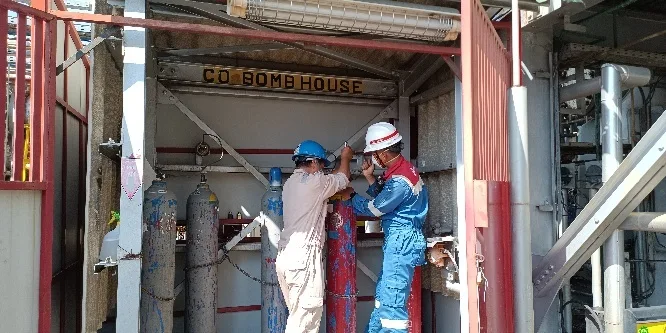
CO bomb house
Repaired a leak in the CO line at the CO bomb house.
Equipment & systems
- Honeywell STG77L
- 4–20 mA
- HART
- Fluke 754
- Pneumatic hand pump
- Digital multimeter
- 24 VDC loop supply
- DCS
- Interlock / ESD
- Preventive maintenance
Related Work